It's 2 AM and You're Still Staring at 30 Chrome Tabs — Sound Familiar?
Picture this: It's Friday, 4:00 PM. Your boss Slacks you, "Need a competitor analysis deck and a landing page wireframe by 4:30."
You open 30 tabs. Copy-paste until your eyes blur. Write in Google Docs, delete, rewrite. You ship the deck, but deep down you know it's half-baked. The worst part? You know it'll happen again next week.
If you're a solo marketer, content creator, or early-stage founder, this scene is painfully familiar. Everyone says "AI saves you time" — but after subscribing to ChatGPT, Claude, Notion AI, and Zapier, you realize the time you "saved" got eaten up learning how to use all of them. The real bottleneck isn't "which AI tool is better." It's how to stitch them into a true end-to-end pipeline.
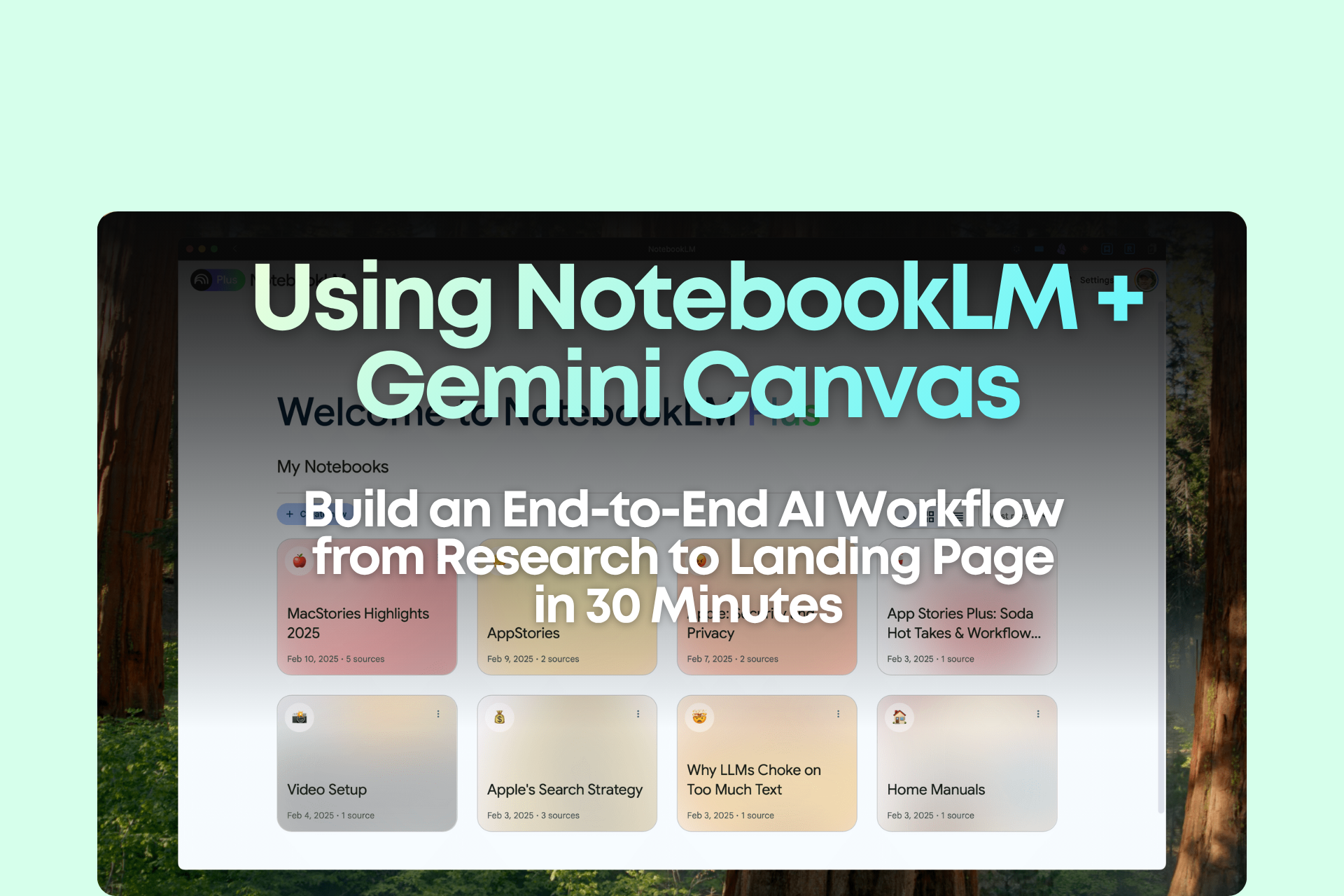
At NextMaven, we've helped over 200 SMB owners and solo marketers operationalize AI workflows, and we've spotted a pattern — the people who actually win aren't the ones using the most AI tools. They're the ones who pick 2–3 tools and wire them into a pipeline. And in 2026, one of the highest-ROI pipelines is the combo Google quietly rolled out: NotebookLM + Gemini Canvas.
In the next few minutes I'll break down this workflow step by step: how to go from zero sources to a finished executive summary, counter-intuitive insights, and a live landing page — all in under 30 minutes. I'll hand you the exact prompt templates our internal team uses. Let's go.
The Real Enemy of a Solo Marketer Isn't "Not Enough Time" — It's Context Switching
Here's an uncomfortable truth: you're not slow because you're lazy. You're slow because you switch tools all day.
A typical solo marketer's morning looks like this:
- Google 5 competitors → open 30 tabs
- Paste into ChatGPT to summarize → then go back to originals to fact-check because you don't trust it
- Open Notion to build a briefing doc → manual copy-paste
- Open Figma / Framer for a wireframe → re-explain context from scratch
- Open Canva for social assets → re-explain your brand tone again
Every tool switch costs your brain 23 minutes to refocus (University of California research). So your "8-hour workday" is really 3 hours of actual output.
"The real reason AI isn't saving you time is this: every time you switch tools, you have to re-brief the context from zero."
The fix isn't finding more AI tools. It's finding one central brain — a single place that holds all your sources and context, and outputs different formats on demand. That's exactly what NotebookLM is.
Why NotebookLM Is the Solo Marketer's Secret Weapon (Not ChatGPT)
Most people's first reaction: "I already have ChatGPT. Why bother learning NotebookLM?"
One-liner: ChatGPT helps you think. NotebookLM helps you execute.
Feature
ChatGPT
NotebookLM
Source control
Pulls from the internet, can hallucinate
Only cites sources you upload
Citations
No inline citations
Every claim has a clickable number that jumps to the source paragraph
Output formats
Text only
Mind Map / Slides / Data Tables / Podcast
Deep Research
Pro tier only
Available on free tier
Website generation
Requires code
One-prompt site via Gemini Canvas
The killer feature for solo marketers is #2 — inline citations. Every claim in your report is verifiable in 0.5 seconds. No more anxiety about your boss catching an AI hallucination in a Monday meeting.
The Workflow: From Zero to Live Landing Page in 30 Minutes
This is the exact SOP we teach inside NextMaven Membership. The target outcome: a solo marketer completes an 8-hour "research + strategic insight + landing page" task in 30 minutes.
Stage 1: Scrape 10 High-Quality Sources in 10 Minutes (Deep Research)
Old way: 30 Google tabs, copy-paste, cross-reference — 3 hours minimum.
New way:
- Open NotebookLM, click Add Source → Deep Research
- Paste this prompt (swap the topic to whatever you need):
Research the current state of AI agents in 2026, including market landscape, technical architecture, enterprise use cases, regulation, safety risks, and investment trends.
- Hit Generate. Wait 3–5 minutes.
NotebookLM automatically does four things:
- Plan — breaks your topic into 5–6 sub-questions
- Crawl — scrapes dozens of sources across the web
- Filter — drops low-quality blogs, keeps papers, official docs, and top-tier publications
- Import — converts them into 10 ready-to-query sources inside your notebook
Pro Tip: Deep Research has a daily quota. Use Fast Research for familiar topics, save Deep Research for unfamiliar territory — that's where the ROI is.
Stage 2: Generate an Executive Summary in 5 Minutes (Not Some Generic Overview)
Now that you have sources, here's where most people blow it — they type "summarize this." Garbage in, garbage out.
Instead, use this structured executive summary prompt. It's the format we use for client reports:
Based on these 5 sources, create a concise executive summary
about how AI is transforming work.
Include:
1. Main thesis
2. 5 key insights
3. Risks and limitations
4. Practical business implications
Write it in a structured format.
Why this prompt works: it forces the AI to think across four different dimensions (thesis / insight / risk / business implication) instead of just paraphrasing. The output can be pasted directly as slide 2 of your client deck.
Stage 3: Mine 3 Counter-Intuitive Insights (The Stuff That's Actually Worth Money)
This is where solo marketers get their unfair advantage. The average marketer stops at the summary. But if you want your deck to make your boss go "damn" — or make a client think "this person sees things I don't" — you need counter-intuitive insights: points that feel wrong on the surface but are backed by data.
In the same notebook, run these three prompts (we call this the Insight Triple Punch):
Prompt 1 — Counter-Intuitive Mining
List the 3 most counter-intuitive points.
Prompt 2 — Contradiction Detection
Where do these sources contradict each other?
Prompt 3 — Framework Synthesis
Synthesize the core arguments from these sources into a structured framework. Output as a table.
These three prompts extract, respectively:
- Unexpected angles (essential for any pitch deck)
- Contradictions between sources (makes you sound like a critical thinker instead of a source parrot)
- A visual framework (table copies straight into your deck)
One afternoon gives you a week's worth of research depth.
Stage 4: Stress-Test Your Analysis in "Harsh Business Coach" Mode
Most people stop here and ship. But the gap between a good marketer and a great one is this stage — self-stress-testing before you ship.
NotebookLM Chat has a Configure button where you can set a Custom Persona. Paste this:
Persona Setup:
You are a harsh business coach with 20 years of experience. Challenge assumptions, point out weak thinking, and be direct.
Follow-up Question:
Based on this AI work transformation summary, what are the biggest weaknesses or blind spots in this analysis?
The AI flips personas — it's no longer agreeing with you, it's tearing into you. Expect it to call out:
- Where your summary over-generalizes
- Which assumptions aren't backed by data
- Where you have survivorship bias
- The exact questions your boss will grill you on
This is the most overlooked edge available to solo marketers — you don't have teammates to peer review, but AI can be your senior advisor. After one round of this, your deck quality pulls away from 80% of your peers.
Stage 5: Ship a Landing Page With One Prompt (Gemini Canvas)
Now for the magic moment.
- In NotebookLM Studio, click Reports → Briefing Doc, export to Google Docs
- Open gemini.google.com
- Paste the Google Doc URL into the chat
- In the tool bar below, select Canvas. The interface splits (left: chat / right: live preview)
- Paste this prompt:
Transform this content into a modern minimalist personal
knowledge landing page, featuring a hero section, three
content cards corresponding to three major trends, a
navigation menu, and a dark mode toggle. The style should
reference Linear and the Vercel landing page.
Notice the structure of that prompt — this is the Canvas Prompt Golden Formula:
- Output type: personal knowledge landing page
- Aesthetic: modern minimalist
- Components: hero / 3 content cards / nav menu / dark mode toggle
- Reference: Linear / Vercel
All four elements are non-negotiable. Drop any one of them and you'll get a generic result.
- Hit Enter. Watch it generate section by section.
- Top-right corner: Share → Copy link. You now have a live URL.
Pro Tip: The direct publish feature currently only works on personal Google accounts. On Workspace accounts, the Share button is disabled — use a personal account to ship.
How to Apply This: A Solo Marketer's Weekly Workflow Template
Knowing the tool is useless. Turning it into a habit is where compounding kicks in. Here's the weekly cadence we recommend:
Monday — Research Day
- Deep Research this week's campaign topic
- Run the Executive Summary prompt
- Run the Insight Triple Punch (counter-intuitive / contradiction / framework)
Tuesday — Stress Test Day
- Switch to the harsh business coach persona, run a weakness audit
- Revise your briefing based on the feedback
- Finalize the executive summary
Wednesday–Thursday — Production Day
- Use the same notebook's sources to produce everything
- Blog post / email / social posts / sales copy
- Because everything references the same source pool, your brand tone stays consistent automatically
Friday — Ship Day
- Use Gemini Canvas to build the landing page or microsite
- Export the briefing doc into a client deck
- Schedule all social posts
The 3 Most Common Implementation Blockers
Blocker 1 — Hitting the 50-source ceiling
Use the Convert to Source trick: save a chat answer as a note, then convert that note back into a source. But one rule: for every 5 original sources, convert at most 1 summary. Never chain beyond 3 layers. Otherwise the AI starts citing its own errors and drifts further from truth with each layer.
Blocker 2 — Keeping brand tone consistent
Upload one of your best-performing past pieces as a source. Then start every prompt with "Match the tone and style of [document name]."
Blocker 3 — Getting your team on board
Create a shared notebook. Upload brand guidelines, SOPs, and past campaign data as sources. New hires onboard by getting the notebook link — they'll be writing in your brand voice within a day.
Inside NextMaven Membership, we've packaged this as the NotebookLM Solo Marketer SOP Pack — containing every prompt template in this post, the weekly workflow checklist, and brand tone training templates. Members download it, swap in their own topic, and ship.
The Bottom Line: The New Standard for 2026 Knowledge Workers
Step back and look at what just happened — the same "research + insight + landing page" task went from 8 hours to 30 minutes. Not because you worked harder, but because your workflow shifted dimensions.
"The 2026 competitive edge isn't 'who works more overtime.' It's 'whose AI pipeline is built better.'"
For solo marketers, this shift is seismic. In the past, one person genuinely couldn't match a full team's output. Today, one operator who knows how to orchestrate AI workflows can legitimately out-ship a 5-person team. That's why we're seeing more and more solopreneurs crack 7-figure revenue without hiring.
But be honest with yourself — tools are just tools. The workflow only works if the strategy, brand positioning, and customer insight underneath are solid. NotebookLM + Gemini Canvas compress your execution time, not your thinking time. Use the time you save to think harder about strategy and talk to more customers. Those are the two things AI still can't do for you.
Starting today, pick one research task from next week's to-do list and run it through this 5-stage workflow. Once you do it once, you'll get why I say ChatGPT is just the entry ticket — NotebookLM + Gemini Canvas is the actual dividing line in 2026.