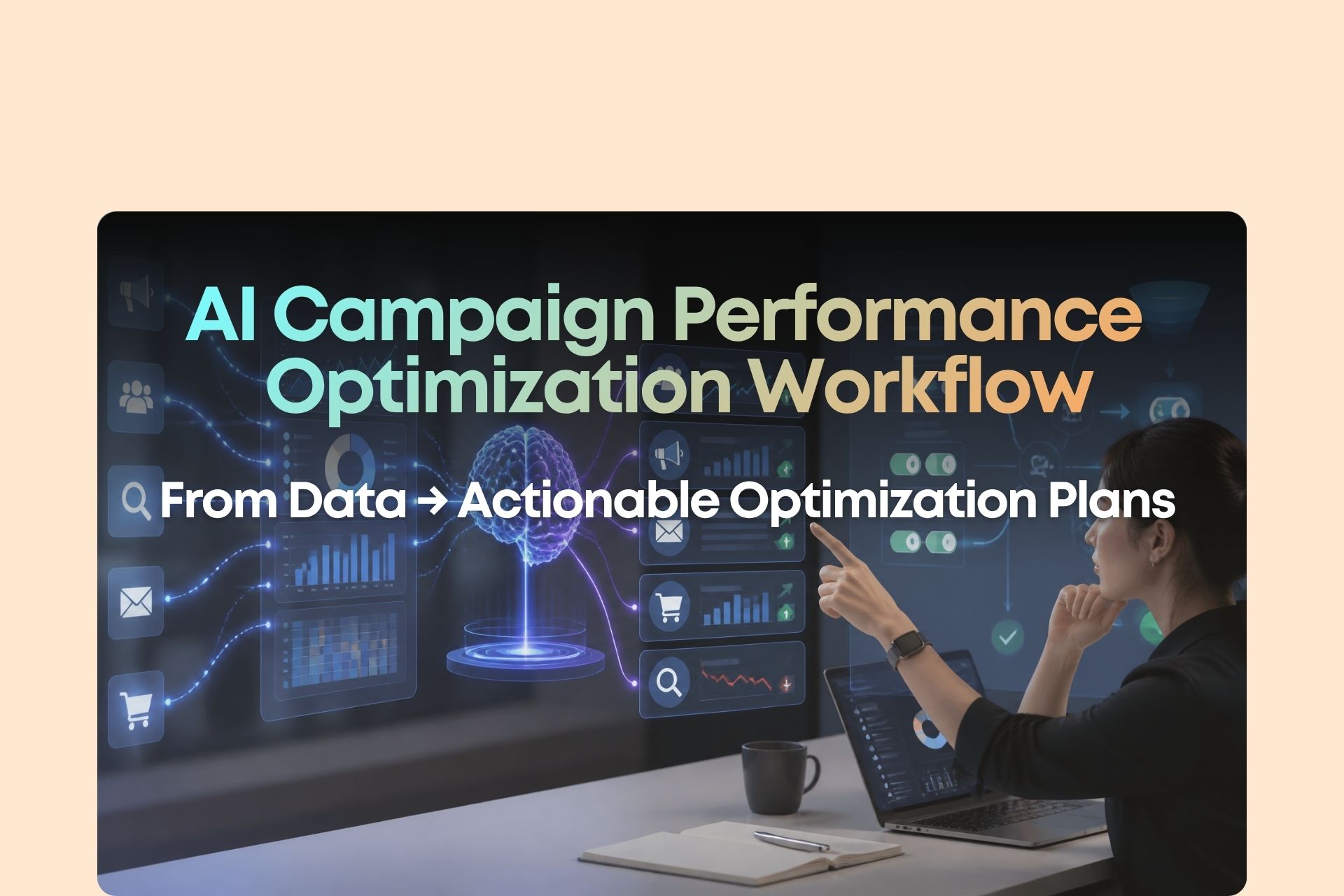
Are You Stuck Looking at Data… But Not Knowing What to Do?
Every day, you open Meta Ads or Google Ads and see:
- CTR dropping
- CPA increasing
- ROAS declining
You know there’s a problem.
But the real challenge is:
👉 What exactly should you change? Where? And how much?
Most performance marketers get stuck here:
- Data → Insight (done)
- Insight → Action (stuck)
And that leads to:
- Random changes (e.g. swapping creatives blindly)
- Over-optimization (resetting learning phase)
- Or worse… doing nothing
“The problem isn’t lack of data — it’s lack of executable decision logic.”
At NextMaven, we’ve helped marketers build AI-powered workflows, and the most effective systems always do this:
👉 Data → Automatically identify issues → Output executable action plans
Not reports. Not dashboards.
👉 Actual decisions you can implement immediately.
This guide breaks down a semi-automated AI Campaign Optimization Workflow (AI + human decision-making).
Step 1|Data Collection (Non-LLM): Your Foundation Matters
No matter how powerful your AI is — bad data = bad decisions.
🎯 Required Data Sources
- Meta Ads API
- Google Ads API
📊 Required Metrics & Dimensions
- Campaign / Ad set / Ad level
- CTR / CPC / CPA / ROAS / Frequency
- Spend / Conversion / Impressions
- Audience / Creative / Placement
⚠️ Two Critical Factors Most People Miss
1️⃣ Time Comparison (Context is Everything)
Always include:
- Last 7 days
- Previous 7 days
👉 Without this, you can’t distinguish trends from noise.
2️⃣ Breakdown (Root Cause Analysis)
You must break down by:
- Audience
- Creative
- Placement
👉 Otherwise, you’ll know what’s wrong, but not where it’s wrong.
Step 2|AI Analysis: From Data Monitoring to Problem Detection
Your AI agent should focus on just two things:
① Performance Benchmarking
Automatically compare against:
- Account average
- Historical best
Example:
- CTR 30% below average → 🚨 Flag
- CPA 25% above target → 🚨 Flag
② Anomaly Detection
Using rule-based + simple ML:
- Sudden CTR drop
- CPA spikes
- High frequency (creative fatigue)
- Spend increases but conversions stay flat
🔍 Example Output
Ad Set A
- CTR ↓ 40% (vs last week)
- Frequency = 4.2
👉 Status: Creative fatigue
“AI shouldn’t just show data — it should highlight problems automatically.”
Step 3|Strategy Generation: From Insights → Decision Logic
This is where most workflows fail.
Typical output: “Try new creatives”
👉 That’s not enough.
You need a Decision Engine.
① Rule-Based Decision Engine (Core Layer)
Turn data into rules:
Examples:
- IF CTR low + high impressions
→ Change creative angle - IF CPA high + CTR normal
→ Fix audience targeting - IF Frequency > 3.5
→ Refresh creative - IF ROAS below target + high spend
→ Pause ad set
② AI-Generated Execution Plans
Not just what to do — but how to do it
Creative Suggestions:
- New hooks
- UGC / testimonial / demo formats
Audience Suggestions:
- Lookalike expansion (e.g. 3% → 5%)
- Interest expansion
③ Prioritization (Most Overlooked)
Not everything should be optimized.
🎯 Priority Rules:
- 🔴 High: High spend + low performance
- 🟡 Medium: Moderate issues
- ⚪ Low: Low spend → monitor
“Optimization isn’t about doing more — it’s about fixing what impacts ROI most.”
Step 4|Human Approval: AI is Not Autopilot
AI suggests. Humans decide.
👨💻 Your Role as a Marketer:
- Validate AI recommendations
- Avoid changing too many variables
- Prevent learning phase resets
⚠️ Guardrails (This Determines Success or Failure)
Without guardrails, automation becomes dangerous.
1️⃣ Budget Protection
👉 Do not pause more than 30% of total spend at once
2️⃣ Learning Phase Protection
👉 No changes for campaigns under 3 days
3️⃣ Change Limits
Per cycle:
- Max 2–3 ad sets
- Max 1–2 variables
4️⃣ Confidence Threshold
👉 Low conversion volume = no action
💡 Deliverable: Stop Sending Reports — Start Sending Plans
Your AI output should be:
👉 Weekly Optimization Plan
🚨 1. Key Issues
Top 3 problems:
- Rising CPA
- Dropping CTR
- High frequency
🎯 2. Action Plan
Priority
Campaign
Issue
Action
🔴 High
Campaign A
High CPA
Pause Ad Set 3
🔴 High
Campaign B
Low CTR
Test new hook
🟡 Mid
Campaign C
High frequency
Refresh creative
🧪 3. Testing Plan
- Test 1: New UGC angle
- Test 2: LAL 3% → 5%
📊 4. Expected Impact
- CPA ↓ 15–25%
- CTR ↑ 20%
🚀 How to Apply This (Step-by-Step)
Want to build this system from scratch?
Follow this framework:
Step 1: Data Pipeline
- Use APIs / Zapier / Make
- Store in Google Sheets / Airtable
Step 2: AI Analysis Layer
- Use GPT / Claude for benchmarking
- Add rule-based anomaly detection
Step 3: Decision Engine
- Build IF/THEN rule library
- Continuously refine
Step 4: Output Template
- Standardize Weekly Plan format
- Make it execution-ready
💡 Content Upgrade Idea:
Download “AI Campaign Optimization Template (Notion + Prompts)”
🔥 Bonus: Advanced Strategies
1️⃣ Auto-Generated Creative Briefs
AI outputs:
- Hook
- Script
- Visual direction
2️⃣ Cross-Channel Learning
Analyze Meta + Google together:
👉 Identify winning angles
3️⃣ Feedback Loop (Most Important)
Feed results back into the system:
- Success → reinforce rules
- Failure → adjust logic
“The real advantage isn’t AI — it’s a system that gets smarter over time.”
Conclusion: From Analyst to Decision System
The future of performance marketing is not:
👉 Analyze → Think → Slowly test
It’s:
👉 AI detects → System recommends → Humans approve → Rapid iteration
Once you implement this workflow:
- Decision speed increases 3–5x
- Fewer optimization mistakes
- More stable ROI
Most importantly:
👉 You stop being the person who reads data — and become the one who controls the system.