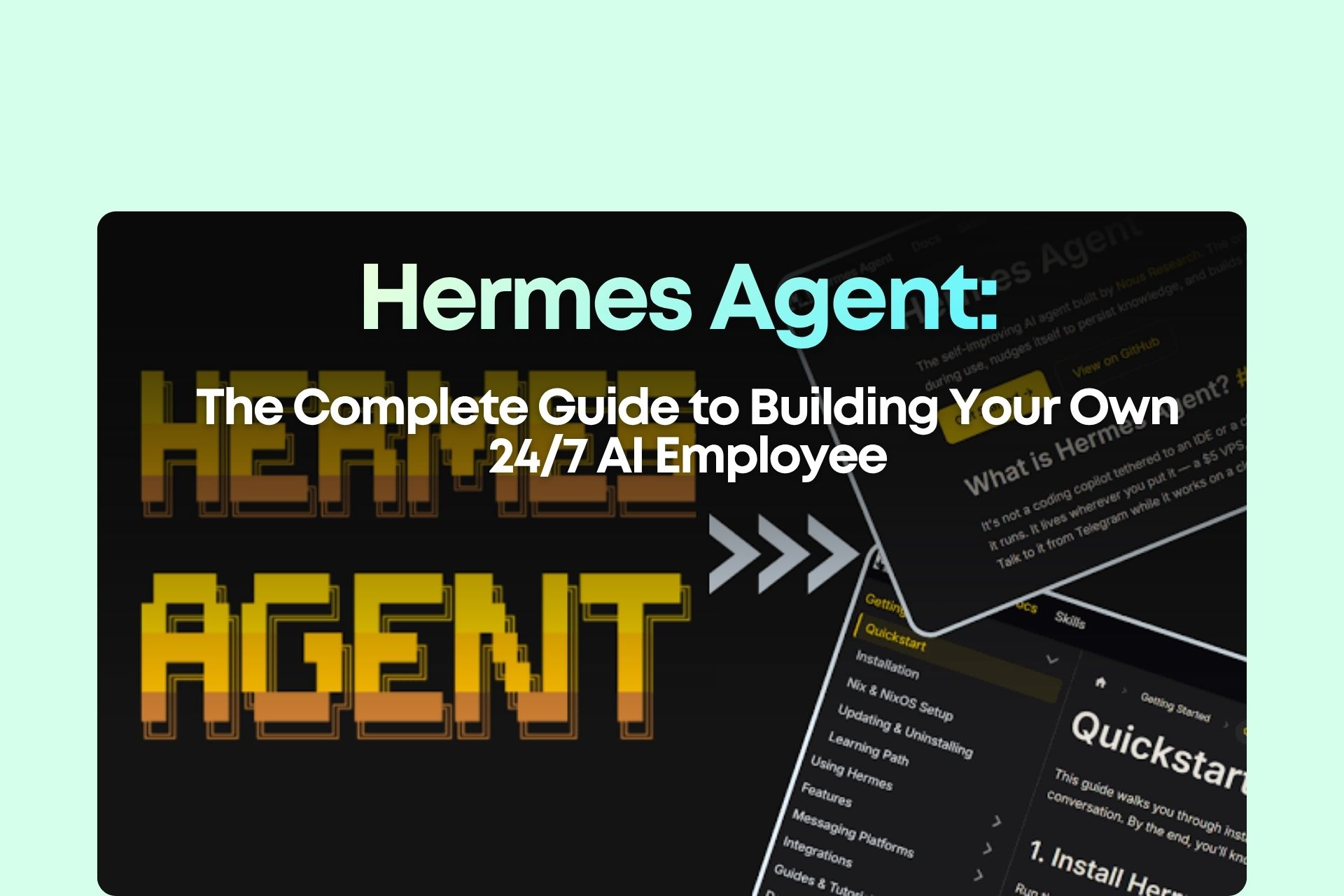
Hermes Agent: How to Build Your Own 24/7 AI Employee
If you've been using ChatGPT, Claude, Gemini, or even Claude Code, you've probably noticed the same limitation.
AI has become incredibly powerful, but the way we use it hasn't changed much.
Every new conversation starts from scratch. You have to explain the context again, rewrite prompts, and repeat the same instructions for recurring tasks. Even if AI generates content in seconds, you're still spending valuable time managing the process.
The real bottleneck isn't the intelligence of AI—it's the fact that most AI tools still operate as chatbots rather than autonomous workers.
That's where Hermes Agent comes in.
Instead of acting like another chatbot, Hermes Agent functions as an AI agent that can work continuously, remember previous tasks, build reusable workflows, and complete complex jobs with minimal human intervention.
Rather than answering one question at a time, it can research information, use external tools, organize data, execute workflows, and even learn from completed tasks by turning them into reusable skills.
Even better, Hermes Agent can be self-hosted on your own VPS, giving you complete control over your AI infrastructure without relying on a single platform or worrying about changing subscription plans, API restrictions, or regional limitations.
In this guide, we'll explore what Hermes Agent is, how it compares to tools like Claude Code and Codex, how to deploy it, connect it with OpenRouter, create reusable Skills, manage it remotely through Telegram, and optimize both security and operating costs.
What Is Hermes Agent?
Hermes Agent is designed to be much more than an AI chatbot.
Traditional AI assistants follow a simple workflow:
You ask a question.
The AI generates an answer.
The conversation ends.
Hermes Agent takes a completely different approach.
Instead of simply responding, it receives a goal and figures out how to accomplish it.
It can search the web, analyze information, use APIs, execute tools, organize files, save results, and continue working without requiring constant supervision.
For example, you could assign Hermes Agent to:
- Research the latest AI industry news every morning
- Monitor competitors and summarize new product launches
- Generate weekly marketing reports
- Organize research into structured documents
- Build automated content workflows
Once the workflow has been completed, Hermes Agent can save the entire process as a reusable Skill, allowing future tasks to run with a single instruction instead of rebuilding everything from scratch.
This shift—from answering questions to completing work—is what makes AI agents fundamentally different from chatbots.
Why More Businesses Are Adopting AI Agents
Over the past year, the conversation around AI has changed dramatically.
Businesses are no longer looking for tools that simply generate text faster.
They're looking for ways to eliminate repetitive work altogether.
Whether you're creating content, conducting market research, managing marketing campaigns, or handling administrative tasks, much of your workload follows repeatable processes.
Manually repeating those processes—even with AI assistance—still consumes valuable time.
AI agents automate those workflows.
Instead of writing prompts for every individual task, you define the objective once, and the agent handles the execution automatically.
The result isn't just faster work.
It's a fundamentally different way of working where AI becomes part of your operations rather than just another productivity tool.
Hermes Agent vs Claude Code vs Codex
Claude Code and Codex are outstanding AI development tools, particularly for programmers who need assistance with writing and debugging code.
However, Hermes Agent serves a different purpose.
Rather than focusing solely on coding, Hermes Agent is designed to become a long-term autonomous assistant.
Its biggest advantage isn't that it's smarter than other AI models.
It's that it remembers.
Hermes Agent can retain memory across sessions, build reusable Skills, schedule recurring jobs, operate continuously in the background, and integrate with multiple tools and services.
Instead of restarting every project from scratch, it gradually learns how you work and becomes increasingly efficient over time.
For businesses that want to automate entire workflows instead of isolated tasks, that distinction is significant.
Why Self-Hosting Matters
Many people ask why they should self-host Hermes Agent instead of relying entirely on ChatGPT or another cloud-based AI platform.
The answer comes down to ownership and flexibility.
When your workflows depend entirely on a single provider, you're also dependent on that provider's pricing, rate limits, policies, and feature roadmap.
A subscription increase, API restriction, or regional limitation can immediately disrupt your business processes.
Self-hosting gives you complete control.
You decide which models to use.
You choose where your data lives.
You control your operating costs.
And if you ever want to migrate to another provider, your workflows remain yours.
For creators, agencies, and businesses building long-term AI systems, that level of independence is invaluable.
Deploying Hermes Agent
One of the easiest ways to get started is by deploying Hermes Agent on a VPS that supports one-click installation.
Once your server is ready, the deployment process is largely automated.
After logging in for the first time, however, there are several essential tasks you should complete immediately.
Change the default administrator password.
Enable HTTPS.
Update the operating system.
Configure your firewall.
Set up SSH key authentication.
These steps only take a few minutes but dramatically improve the security of your server.
Many tutorials focus on how quickly you can install Hermes Agent while overlooking the importance of securing it properly from day one.
Connecting Hermes Agent with OpenRouter
Hermes Agent doesn't include its own language model.
Instead, it connects to external AI providers.
One of the most flexible options is OpenRouter.
With a single API key, you can access multiple leading AI models, including GPT, Claude, Gemini, DeepSeek, Qwen, and Llama.
This flexibility allows you to choose the best model for each specific task.
For example, you might use a lower-cost model for research and data collection, while reserving a premium model for writing polished marketing content.
If one provider experiences downtime or increases pricing, switching models takes only a few clicks instead of rebuilding your entire workflow.
Building Reusable Skills
One of Hermes Agent's most powerful features is its Skill system.
Most AI chatbots require you to repeat prompts every time you start a new conversation.
Hermes Agent can remember successful workflows.
Imagine asking the agent to create a weekly AI news summary.
The first time, it searches trusted sources, filters important stories, organizes the information, and produces a formatted report.
Instead of discarding that process afterward, Hermes Agent saves it as a Skill.
The following week, you only need to give a simple instruction, and the entire workflow runs automatically.
As your Skill library grows, so does the value of your AI system.
Rather than collecting prompts, you're building an intelligent workflow library that continuously improves your productivity.
Managing Hermes Agent from Telegram
Once Hermes Agent is connected to Telegram, managing your AI assistant becomes incredibly convenient.
You no longer need to log into your server every time you want to start a task.
Instead, you can send commands directly from your phone.
Whether you're requesting the latest AI news, launching a research project, approving a workflow, or checking task progress, everything can be done through Telegram.
This remote accessibility makes Hermes Agent practical for entrepreneurs, agencies, and business owners who need their AI systems running continuously—even while they're away from their desks.
Keeping AI Costs Under Control
One of the biggest concerns surrounding AI agents is operating cost.
Without proper safeguards, poorly configured workflows can consume thousands of unnecessary tokens.
Fortunately, cost optimization is straightforward.
Set daily or per-task spending limits to prevent unexpected API charges.
Use different AI models for different workloads instead of relying on premium models for every task.
Create reusable Skills to eliminate unnecessary reasoning on repetitive processes.
Schedule tasks to run only when needed rather than keeping every workflow active around the clock.
A well-designed automation system isn't just faster—it should also be cost-efficient.
Common Mistakes to Avoid
Many first-time users encounter two preventable problems.
The first is uncontrolled API usage.
If an agent enters an infinite retry loop, token consumption can increase rapidly, resulting in unexpectedly high costs.
Always configure spending limits, retry limits, and timeout settings before putting workflows into production.
The second issue is server security.
Leaving default credentials unchanged or exposing your administration dashboard to the public creates unnecessary risk.
Basic security practices—such as strong passwords, firewall rules, HTTPS, and SSH authentication—should always be part of your deployment checklist.
Who Should Use Hermes Agent?
Hermes Agent is ideal for anyone managing repetitive digital workflows.
Content creators can automate research and content preparation.
Marketing teams can monitor trends, competitors, and campaign performance.
Agencies can streamline client reporting and recurring operational tasks.
Solo entrepreneurs can automate work that would normally require an entire team.
If your business relies on repeatable processes, Hermes Agent can gradually transform those manual workflows into autonomous systems.
The more Skills you build, the more capable your AI assistant becomes.
Final Thoughts
The future of AI isn't about asking better questions.
It's about building systems that can complete meaningful work independently.
Hermes Agent represents that shift.
Instead of acting as another chatbot waiting for instructions, it becomes an intelligent worker that remembers processes, automates repetitive tasks, and continuously improves over time.
As more businesses adopt AI-powered automation, the competitive advantage will no longer come from simply using AI.
It will come from building AI systems that can work for you around the clock.
If your goal is to create an AI employee rather than just another AI assistant, Hermes Agent is one of the most compelling open-source platforms available today.