Many consultants, coaches, educators, and service professionals face the same challenge.
They have expertise, products, and proven results, but their marketing infrastructure never feels fully built.
Common situations include:
- Not knowing how to design a landing page
- Needing a designer for every website change
- Not running A/B tests because the tools are complex or expensive
- Not having an SEO lead magnet
- Marketing tasks being done manually
As a result, the marketing system often stays in manual mode.
Recent AI tools are beginning to change this.
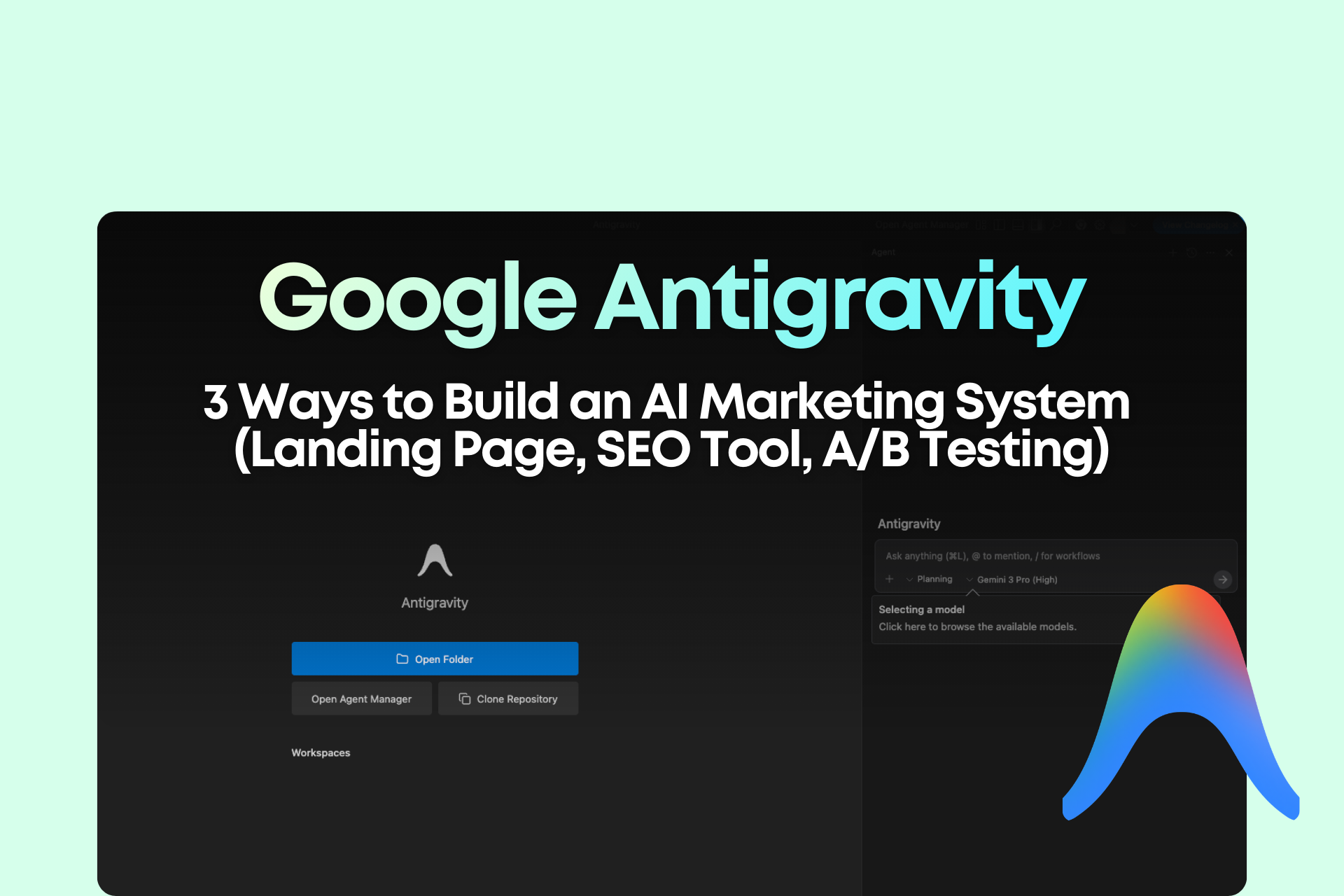
Google Antigravity is an AI coding environment that allows users to build websites, tools, and interactive applications using natural language instructions.
When used correctly, it can help build not just a page, but an entire marketing workflow.
This article explains three practical approaches:
- Building a high-converting landing page
- Creating a free SEO tool to attract search traffic
- Using AI to generate Hero Section A/B tests to improve conversions
Each section also includes prompt templates that can be used directly.
Method 1: Building a High-Converting Landing Page with Plan Mode
One of Antigravity’s most useful features is Plan Mode.
Instead of immediately generating code, Plan Mode first produces an implementation plan.
The plan usually outlines:
- Page structure
- Section layout
- UI components
- Functional logic
After reviewing and approving the plan, the system proceeds to generate the site.
This step significantly reduces the need for rework.
When pages are generated immediately without planning, common issues can appear:
- Layout structure not aligned with the goal
- CTA placement not optimal
- Mobile layout needing redesign
Using Plan Mode usually requires less than a minute to review but prevents many iterations later.
Core Structure of a High-Converting Landing Page
Hero Section
The hero section is the first element visitors see.
It should quickly answer three questions:
- What is the offer
- Who is it for
- What action should the visitor take next
Program Structure or Curriculum
For coaching programs or courses, a clear structure increases credibility.
For example:
Week 1 – Career Clarity
Week 2 – Skills Mapping
Week 3 – Strategy Design
Week 4 – Personal Positioning
Week 5 – Execution
Week 6 – Career Transition Plan
Structured progression helps visitors understand the transformation process.
Social Proof
Testimonials build trust.
Typical testimonial elements include:
- Photo
- Short quote
- Job title or professional role
FAQ Section
FAQ sections address common concerns and reduce hesitation.
Examples might include:
- Who is this program designed for
- How the sessions are scheduled
- Whether prior experience is required
Final CTA Section
The final section of the page reinforces the transformation promise and presents a clear next step.
Landing Page Prompt Template
You are a senior conversion-focused web designer and front-end developer.

Help me build a high-converting landing page for a program called:

Career Reset Bootcamp

Target audience:
Hong Kong working professionals aged 30-45 who feel stuck in their career and want clarity and direction.

Business goal:
Generate sign-ups for a paid 6-week bootcamp.
Primary CTA: Book a Free 15-Min Career Consultation.

Requirements:

1. Full-screen Hero Section
   - Strong emotional headline
   - Supporting subheadline
   - Primary CTA button
   - Background gradient (deep navy to warm orange)

2. 6-week curriculum timeline section
   - Vertical or horizontal interactive timeline
   - Week 1 to Week 6 clearly structured
   - Each week with short outcome description

3. 3 testimonial cards
   - Placeholder image
   - Quote text
   - Name + job title

4. FAQ section
   - 6 common questions
   - Accordion expandable format

5. Final CTA section
   - Orange button
   - High contrast
   - Reinforce transformation promise

IMPORTANT:
First generate a detailed implementation plan outlining all sections, structure, UI components, and logic before writing any code.
Wait for my approval before building.
Method 2: Building a Free SEO Tool to Capture Search Traffic
One of the biggest challenges after creating a landing page is traffic.
Without visitors, even a well-designed page cannot convert.
If paid advertising is not the initial strategy, an effective alternative is creating a free interactive tool.
Compared to standard articles, tools are more likely to:
- Rank in search engines
- Be shared by users
- Keep visitors engaged longer
- Lead naturally into a conversion path
Typical Structure of an SEO Tool Page
Interactive Questionnaire
For example:
10 questions
Each scored from 1 to 5
Displaying one question per screen usually improves completion rates.
Scoring System
Results should be easy to understand.
Example classification:
0–40 Exploration Stage
41–70 Transition Stage
71–100 Acceleration Stage
AI-Generated Personal Insights
AI can generate short personalized advice based on the answers.
Even a short paragraph can significantly increase perceived value.
Results Page
A typical result screen includes:
- Score
- Category
- Interpretation or advice
SEO Structure
The tool page should still include standard SEO components:
- Title tag
- Meta description
- Structured data
- Keyword placement
Free Tool Prompt Template
You are a product designer and full-stack developer.

Help me build a web-based interactive tool called:

Career Clarity Score – Free Online Assessment Tool

Target audience:
Hong Kong professionals aged 28-45 who feel stuck in their career.

Tool Objective:
Generate organic search traffic and convert users into consultation bookings.

Functional Requirements:

1. Questionnaire UI
- 10 career satisfaction questions
- Each question scored from 1 to 5
- Slider input
- One question per screen

2. Scoring Logic
Total score range: 10–50
Convert to a 100-point scale

3. Classification
0–40 Exploration Stage
41–70 Transition Stage
71–100 Acceleration Stage

4. AI Advice
Generate personalized career advice using Gemini API.

5. Results Screen
Show score, category, and AI advice.

IMPORTANT:
First generate a full implementation plan including UI structure and logic before writing any code.
Wait for approval.
Method 3: Using AI to Run Hero Section A/B Tests
Many websites struggle not because of traffic, but because of low conversion rates.
For example, if a landing page conversion rate is 1.8%, it means:
100 visitors enter the page
Only about 2 take action.
Testing different versions of key elements can significantly improve results.
The Hero Section Is the Best Place to Test
The hero section strongly influences:
- First impressions
- Time spent on page
- Initial CTA clicks
Common Psychological Angles for Hero Testing
Fear of Missing Out
Example positioning:
“The workplace is changing rapidly.
Are you adapting — or being left behind?”
Social Proof
Example positioning:
“Hundreds of professionals have successfully reinvented their careers.”
Curiosity Gap
Example positioning:
“Why traditional career paths no longer work for many professionals.”
Testing multiple psychological triggers often reveals which angle resonates most with the target audience.
Hero Section A/B Testing Prompt
You are a senior CRO (Conversion Rate Optimization) strategist.

Context:
My landing page conversion rate is 1.8%.

Target audience:
Hong Kong professionals aged 30-45.

Goal:
Increase consultation booking rate.

Generate 3 Hero Section variations.

Psychological angles:

Version A: Fear of Missing Out
Version B: Social Proof
Version C: Curiosity Gap

Each version must include:
- Headline
- Subheadline
- CTA Button copy
- Psychological trigger explanation

After generating copy, also provide updated Hero HTML snippet.

Do NOT write full page.
Only Hero section.

First outline your strategy logic before generating the versions.
Combining the Three Components into One Marketing Workflow
When these three components work together, they form a simple marketing system:
Search traffic
↓
Free interactive tool
↓
Landing page
↓
Booking or purchase
Each part strengthens the others.
The landing page converts visitors.
The tool attracts search traffic.
A/B testing improves performance over time.
Together, they form a marketing workflow that can continuously attract visitors and improve conversions.