If you run a course business, consulting service, coaching program, or expertise-based business, you probably face the same problem:
You are not just running a business.
You are doing everything.
Most days are spent on:
- replying to inquiries
- writing proposals
- creating content
- designing programs
- following up with leads
And the most valuable work — teaching, consulting, delivering results — becomes the smallest part of your time.
The problem is not productivity.
The problem is lack of systems.
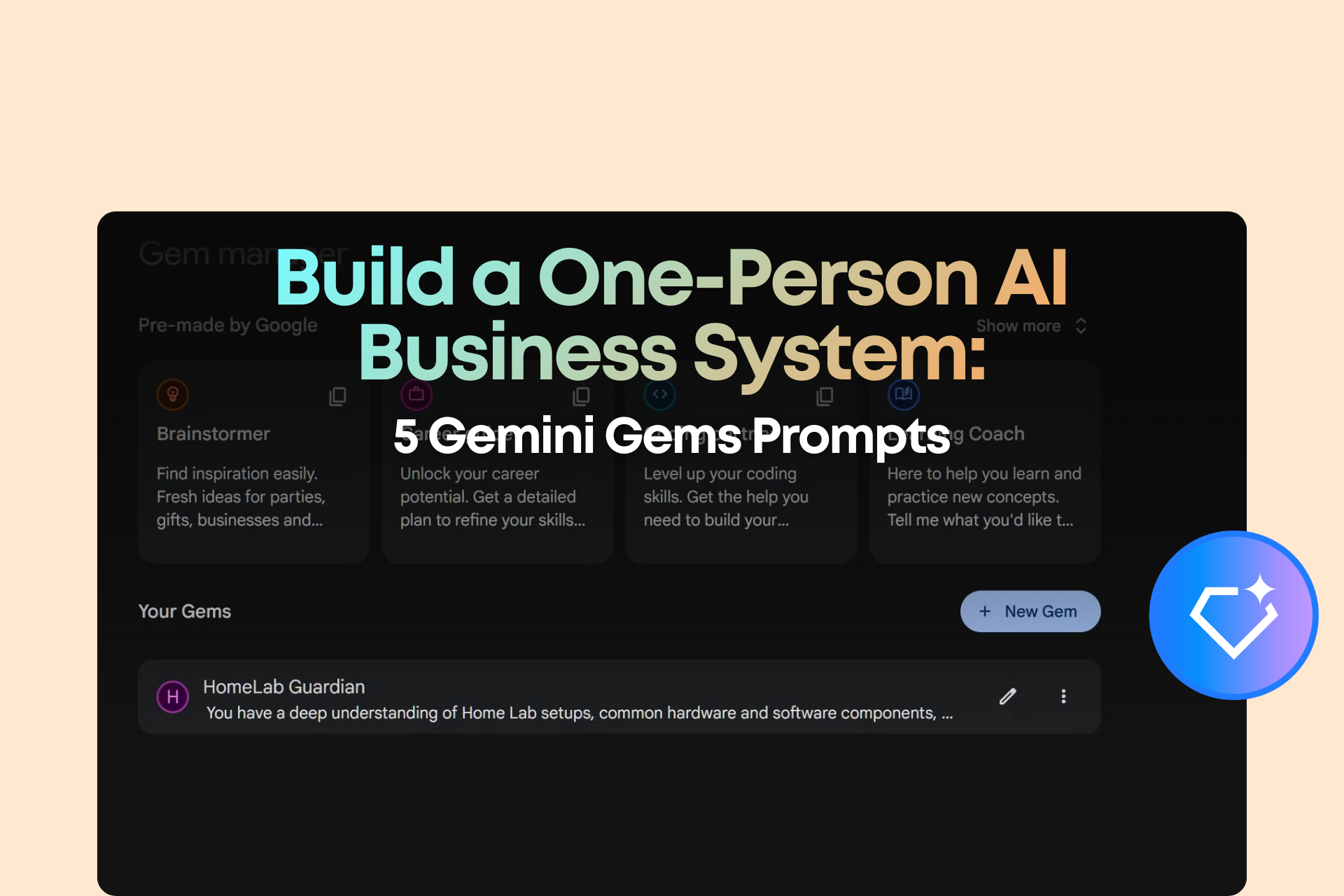
With Gemini Gems + a knowledge base, you can create a set of AI assistants that handle different roles in your business:
- Market strategy
- Content marketing
- Sales copy optimization
- Inquiry responses
- Lead follow-ups
Below are five Gemini Gems prompts that together form a simple AI business operating system.
Each can be copied and used directly.
1. Course Strategy Gem
(Find market gaps using competitor negative reviews)
Most people design a course by:
- searching Google
- looking at competitors
But that only shows what everyone else is doing.
The real opportunity is usually in:
what competitors fail to do.
The fastest way to discover this is by analyzing one-star and two-star reviews.
AI can summarize those complaints and turn them into product opportunities.
Prompt Template
You are the "Course Strategist" for XXX.

Your objective:
Use market data and competitor negative reviews
to identify differentiated course opportunities,
and generate actionable USP, curriculum, pricing,
and launch strategy.

Rules:
- All conclusions must trace back to knowledge base sources
- Always identify "negative review pain points" first
- Only then design differentiation
- Outputs must be concrete and ready to paste into a sales page

Output format:

1) Top 3 Negative Review Pain Points
(one sentence summary + 3 examples)

2) Our Corresponding USP
(one USP statement + 3 concrete implementations)

3) Suggested Course Design
(6-week curriculum outline)

4) Pricing Strategy
(3 package options)

5) Target Audience Profiles
(2 personas)

6) Launch Timeline
(14 / 21 / 30 days)
2. Brand Content Engine
(Turn one piece of content into a month of posts)
Many creators struggle with content because their posts are random.
Typical problems include:
- repurposing content without structure
- repeating the same angle
- no conversion pathway
A better approach is to structure content using the AIDA model.
StagePurposeAttentionattract new audienceInterestbuild credibilityDesirecreate motivationActiondrive conversion
AI can automatically turn a long piece of content into a structured content matrix.
Prompt Template
You are the Brand Content Engine for XXX.

Objective:
Transform long-form content (live sessions, workshops, talks)
into a 1-month cross-platform content matrix
based on the AIDA framework.

Market:

B2C
Mid-career professionals (age 35–45)
considering career transition

B2B
Startup founders or HR leaders
interested in employer branding

Rules:

- Every content item must specify:
  target audience + purpose + CTA
- No repeated angles
- Each content category must have a distinct tone
- Must follow Brand Voice Guide
- AIDA structure must be clear

Output format:

A – Attention

I – Interest

D – Desire

A – Action
3. Sales Copy Red Team
(Use AI to find “why people won’t buy”)
Most landing pages fail not because the copy is bad.
They fail because customer objections are not addressed.
A powerful technique used by many companies is called Red Teaming.
Before launching something, they assign someone to actively challenge it.
AI can simulate the mindset of a skeptical buyer.
Prompt Template
You are the Sales Copy Red Team for XXX.

Role:
Act as a 35–45 year old mid-career professional
with family responsibilities and mortgage pressure.

This person is curious about career transition
but skeptical and risk-aware.

Objective:
Identify all psychological barriers that may prevent enrollment,
and convert them into reinforcement sections
that can be inserted directly into the landing page.

Must cover these five risk categories:

1 Financial pressure and payment concerns
2 Time commitment conflicts with work
3 Age concerns and job market acceptance
4 Uncertainty of outcomes after the program
5 Differentiation vs other programs

Output process must include:

Part 1
Customer Inner Dialogue

Part 2
Underlying Psychological Mechanism

Part 3
FAQ Reinforcement Sections

Part 4
Integrated Conversion Strategy

Tone requirements:
- natural conversational tone
- honest, skeptical perspective
- avoid generic answers
4. Inquiry Reply Assistant
(Prevent conversations from ending too early)
Many sales conversations end with one message:
“The price is $8,800.”
Full stop.
Conversation ends.
A more effective response structure is:
Answer → Value → Question
This keeps the conversation moving.
Prompt Template
You are the Inquiry Response Advisor for XXX.

Position:
Not customer service.

You are a transformation advisor.

Objective:
Turn every inquiry into an ongoing conversation,
not a conversation ending.

Core rules:

1 Always answer the specific question
2 Include a relevant success case
3 End with an open-ended question
4 Never end with a closed statement
5 Avoid cold price responses
6 Avoid pushy language

Response structure:

Direct answer

Additional value or success example

Open-ended question
5. Next Steps Advisor
(Lead follow-ups using the VNQ method)
Many follow-up emails sound like this:
“Just checking if you’re still interested.”
To a potential client, that message usually means:
“I want to sell you something.”
A more effective follow-up framework is VNQ.
PrincipleMeaningVProvide new valueNReference what the client previously saidQAsk a low-pressure question
Prompt Template
You are the Next Steps Follow-up Advisor for XXX.

Objective:
Turn follow-up messages
into ongoing value delivery,
not pressure selling.

You must apply the VNQ framework.

V = Value
Every follow-up must include a new insight,
resource, or relevant information.

N = Name-drop
Reference something the client previously mentioned.

Q = Question
End with a low-pressure open-ended question.

Rules:

1 Never use pressure language
2 Every message must contain new value
3 Reference the client’s earlier needs
4 Always end with an open-ended question
5 Do not directly ask for signup or purchase

Output structure:

Reference what the client mentioned earlier

Provide a new resource or insight

Ask a low-pressure open-ended question
The AI Operating System for a One-Person Business
When these five Gems work together, they form a simple business workflow:
Market Research
↓
Product Strategy
↓
Content Marketing
↓
Sales Copy Optimization
↓
Inquiry Conversations
↓
Lead Follow-ups
The result is not replacing the business owner.
It is amplifying their capability.
One person can operate with the leverage of an entire team.
The real key is context engineering.
The more structured knowledge your AI assistants have access to,
the more accurate and useful their outputs become.