The Real Problem Isn’t the Tool — It’s the Deployment Strategy
If you’ve been exploring AI agents for your business, you’ve probably hit this fork in the road:
- Do I self-host something like OpenClaw for full control?
- Or do I use a cloud-based version like Kimi Claw and get started instantly?
On paper, OpenClaw sounds powerful: open-source, customizable, flexible, model-agnostic. You can connect Claude, GPT, Kimi K2.5 — whatever fits your workflow.
But then reality hits.
You’re dealing with:
- CLI commands
- Server setup
- API key management
- Version conflicts
- Storage configuration
- Skill/plugin wiring
Suddenly, what was supposed to “save time” becomes a week-long DevOps project.
On the other side, Kimi Claw promises:
- Browser-based access
- No server setup
- Built-in storage
- Ready-to-use skills
- Advanced search and extraction APIs
It’s fast. It’s convenient. But now you’re wondering:
- Am I locked into the platform?
- What about data control?
- Will long-term costs spiral?
- Can I deeply customize workflows?
At NextMaven, we see this mistake constantly: businesses don’t fail with AI because the tool is weak — they fail because the deployment model doesn’t match their stage, skill level, or operational needs.
This guide gives you a simple 5-minute decision framework so you can confidently choose the right path — and actually get ROI from AI agents.
Let’s break it down.
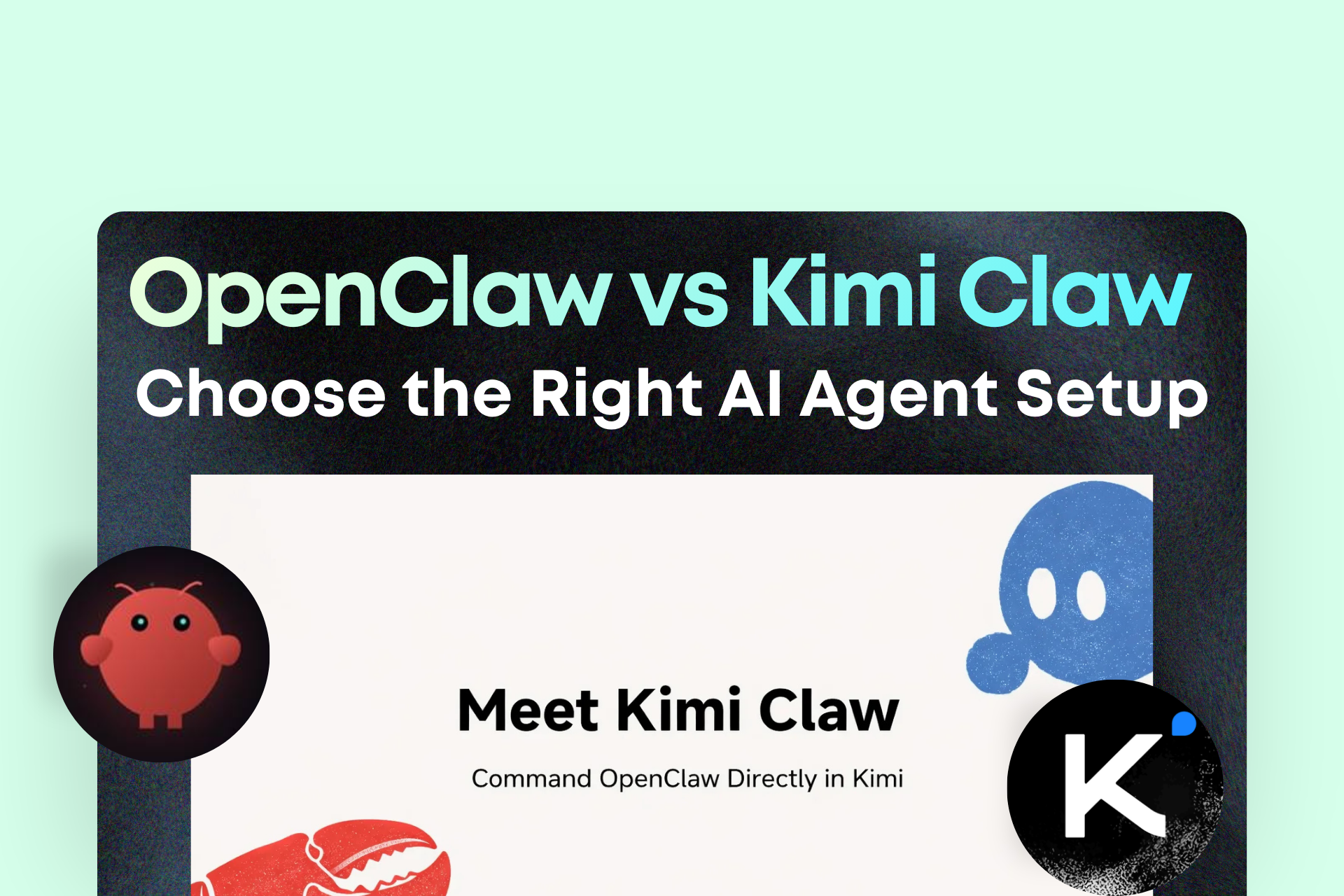
OpenClaw vs Kimi Claw: What’s the Core Difference?
In one sentence:
- OpenClaw = The engine. Full flexibility. You build and maintain it.
- Kimi Claw = The deployed cloud experience. Fast setup. Platform-managed.
Think of it like this:
- OpenClaw is building your own performance car.
- Kimi Claw is leasing a high-performance vehicle that’s already tuned.
Both can get you there. The question is: what kind of driver are you?
The 5-Minute Decision Framework
Answer these five questions honestly.
1️⃣ Do You Need Results This Week?
If your goal is:
- Launching automated content workflows
- Setting up research + drafting pipelines
- Automating repetitive data extraction
- Reducing manual marketing ops
And you need it live in 24–72 hours…
👉 Kimi Claw is usually the smarter move.
If you’re building infrastructure for long-term system integration and can invest 1–2 weeks upfront…
👉 OpenClaw becomes more attractive.
Speed vs flexibility. Pick what you need right now.
“The fastest AI system is the one that actually ships.”
2️⃣ Do You Have Someone Who Can Maintain 24/7 Uptime?
Self-hosting OpenClaw means managing:
- Server uptime
- Dependency updates
- Model API changes
- Logs and memory storage
- Security configurations
- Backup and recovery
The biggest failure we see isn’t setup — it’s maintenance.
When your AI agent becomes part of:
- Lead processing
- Reporting
- Customer support drafts
- Content production
Downtime equals lost money.
If you don’t have:
- Technical support
- DevOps habits
- Version control discipline
Cloud deployment (Kimi Claw) dramatically reduces operational risk.
3️⃣ How Sensitive Is Your Data?
This is where OpenClaw shines.
If you’re handling:
- Customer personal data
- Contracts
- Financial data
- Internal proprietary documents
- Enterprise integrations
Self-hosted deployment gives you maximum control.
With Kimi Claw, execution and some storage layers are platform-managed. That may be fine for:
- Public data scraping
- Marketing content
- Competitive research
- General workflow automation
But if compliance or strict internal policies apply, OpenClaw offers more governance flexibility.
4️⃣ How Deep Do You Need Customization?
If your vision includes:
- Custom agent logic rewriting
- Complex multi-step branching flows
- Deep CRM/ERP integration
- Multi-agent collaboration
- Custom memory layers
- Fine-grained permission controls
OpenClaw offers higher extensibility.
Kimi Claw excels at:
- Prebuilt skill libraries
- Rapid workflow assembly
- Immediate productivity
- UI-driven configuration
Ask yourself:
Are you optimizing for experimentation speed or architectural control?
5️⃣ Have You Calculated Total Cost of Ownership (TCO)?
This is where many founders miscalculate.
OpenClaw Costs:
- Cloud server hosting
- Engineering time
- Monitoring tools
- Maintenance labor
- Downtime risk
Kimi Claw Costs:
- Subscription tiers
- Usage-based API costs
- Advanced feature pricing
- Platform dependency
Here’s the key insight:
The cheapest tool is the one that generates ROI fastest.
If self-hosting delays you by 3 weeks, what’s that opportunity cost worth?
If cloud costs scale aggressively at high usage, what’s your long-term projection?
Don’t compare price. Compare outcome speed and risk.
The Smartest Strategy: You Don’t Have to Choose Forever
Most businesses think this is a permanent decision.
It isn’t.
Path A: Fast Start (Cloud First)
- Launch with Kimi Claw
- Validate ROI with one high-value workflow
- Track time saved and output quality
- Optimize for 30 days
Then decide whether to scale or migrate.
Best for:
- Solo founders
- Marketing teams
- Non-technical operators
- Agencies testing AI workflows
Path B: Control First (Self-Hosted)
- Define sensitive workflows
- Build minimal OpenClaw architecture
- Establish monitoring + versioning
- Gradually expand use cases
Best for:
- Technical teams
- Enterprises
- Compliance-heavy industries
Path C (Recommended for Most): Cloud → Validate → Self-Host Critical Systems
This hybrid strategy reduces:
- Risk
- Setup waste
- Engineering overbuild
- Misaligned infrastructure
Start where speed matters.
Move to control where scale demands it.
How to Apply This: 3-Step Implementation Plan
Step 1: Identify Your Highest-ROI Workflow
Choose a process that:
- Repeats weekly
- Takes 30+ minutes each time
- Has measurable output
- Can be structured
Examples:
- Trend research → Content drafts
- Lead intake → Classification → Follow-up drafts
- Report aggregation → Insights summary
Don’t automate everything. Automate the most expensive repetition.
Step 2: Build a Minimal Viable Agent (MVA)
Cloud MVA Setup:
- 1–3 core skills
- Fixed input format
- Structured output template
- Clear success metric
Self-Hosted MVA Setup:
- Model connection
- Core skill
- Storage layer
- Logging
- Basic monitoring
Ship small. Improve iteratively.
Step 3: Document with SOP + Checklist
The real scaling advantage comes from:
- Prompt templates
- Output formatting standards
- Role-based usage rules
- Clear escalation triggers
At NextMaven, this is where most businesses accelerate — not because they have “better AI,” but because they systemize usage.
AI without structure = chaos.
AI with SOP = leverage.
FAQs
Q1: Is OpenClaw always cheaper?
Not necessarily. Engineering time and maintenance can outweigh cloud subscription costs.
Q2: Is Kimi Claw limiting for advanced workflows?
For deep system integrations and full architecture control, yes. For most marketing workflows, it’s more than sufficient.
Q3: Can I use multiple models with both?
OpenClaw generally offers more flexibility in model selection. Cloud platforms may support multi-model setups depending on implementation.
Q4: What if I choose wrong?
Start with one workflow. Test small. Your first deployment doesn’t define your forever architecture.
Conclusion: Choose Based on Your Bottleneck
OpenClaw and Kimi Claw are both powerful.
The real question is:
What is your current constraint?
- Lack of speed?
- Lack of control?
- Lack of technical resources?
- Compliance requirements?
- Cost sensitivity?
Choose the deployment model that removes your biggest bottleneck first.
Because the goal isn’t to build the most impressive AI system.
The goal is to build the one that actually moves your business forward.