Introduction: How Much Time Do You Lose to Small Tasks Every Day?
If you're a founder, marketer, freelancer, or content creator, your workday likely includes dozens of small repetitive tasks.
Things like:
- Checking Gmail for urgent messages
- Reviewing today's calendar schedule
- Preparing for meetings
- Organizing notes after calls
- Responding to common client requests
Individually, each task seems small. But together, they consume a significant portion of your day.
The real problem isn't the amount of work — it's the number of repetitive workflows that require your attention.
This is where AI automation becomes valuable.
Most people associate AI with generating content. However, the biggest productivity gains often come from automating routine work.
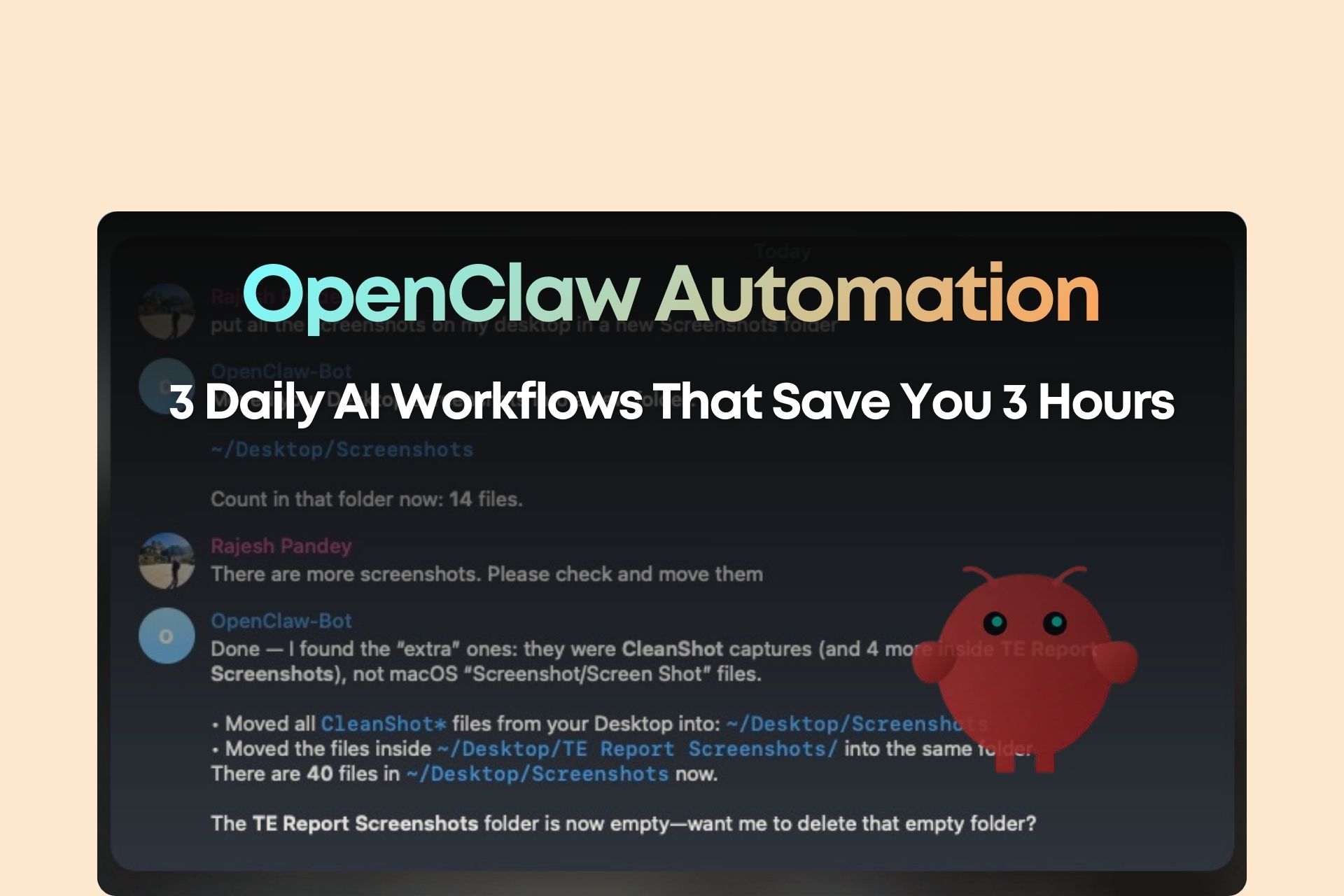
OpenClaw is designed specifically for this purpose. Instead of acting only as a chatbot, it operates as an AI assistant that can run continuously in the background. It can schedule tasks, integrate with external tools, and proactively deliver results when needed.
In other words, OpenClaw doesn't wait for questions — it helps execute workflows.
Below are three practical daily automation use cases that demonstrate how OpenClaw can save hours of routine work.
AI Morning Briefing: Automatically Summarize Your Day
Many people start their workday with the same routine:
- Open Gmail to check for urgent emails
- Open Google Calendar to review meetings
- Check the weather
- Review tasks for the day
These steps rarely change. They simply repeat every morning.
With OpenClaw's scheduled task system (Cron Jobs), this routine can be automated.
You can create a scheduled workflow that runs every morning at a specific time.
For example, a task scheduled at 7:00 AM could perform the following actions:
- Check Google Calendar for today's meetings
- Scan Gmail for urgent messages
- Identify high-priority emails
- Retrieve weather information
- Generate a short daily summary
Once completed, OpenClaw sends the summary directly to your preferred communication channel such as Telegram, Slack, or WhatsApp.
A typical output might look like this:
Good Morning

Today's Schedule
10:00 Client Meeting
14:00 Marketing Review
16:30 Product Demo

Urgent Email
Client A – Proposal Confirmation

Weather
Rain expected in the afternoon
Instead of opening multiple apps, you receive a single consolidated briefing.
This workflow is especially useful for:
- Founders managing multiple projects
- Managers with frequent meetings
- Freelancers handling several clients
By centralizing daily information, you can start the day with a clear overview.
Inbox Automation: Let AI Filter Your Emails
Email is one of the biggest sources of productivity loss.
Most inboxes contain a mix of different message types:
- Newsletters
- Promotional emails
- System notifications
- Client messages
- Internal communication
Only a small percentage of these emails require immediate action, yet people still spend time scanning each one.
OpenClaw can integrate with Gmail or other email platforms to automatically organize and process incoming messages.
The system can classify emails based on predefined rules. For example:
Promotional emails
Automatically archived or labeled
Newsletters
Grouped into a weekly summary
Client emails
Marked as high priority
Internal notifications
Sorted by project or category
Beyond simple sorting, OpenClaw can analyze email content to identify potential action items.
For instance, if a message includes:
- A request for a proposal
- A request for information
- A meeting invitation
- A confirmation request
The AI can automatically draft a response based on your predefined service information or templates.
You can then review the draft and send it with minimal editing.
Another useful automation is periodic inbox monitoring.
OpenClaw can scan your inbox at fixed intervals — for example every 30 minutes — and only notify you when important messages are detected.
Instead of checking email repeatedly throughout the day, you are alerted only when necessary.
This transforms email from a constant interruption into a structured task list.
Meeting Notes to Tasks: Turn Conversations into Action Items
Meetings themselves may not consume excessive time, but the follow-up work often does.
After a meeting, teams usually need to:
- Summarize the discussion
- Extract key decisions
- Identify action items
- Assign responsibilities
- Set deadlines
If a meeting transcript is available — such as from Zoom or Google Meet — OpenClaw can analyze the entire conversation automatically.
The system first generates a concise meeting summary highlighting major discussion points and decisions.
Then it extracts actionable tasks.
For example:
Meeting Summary

Topic
Website redesign project

Key Decisions
New landing page design approved
Timeline adjusted to four weeks

Action Items
John – Send revised proposal by Friday
Sarah – Prepare marketing assets
Alex – Schedule next meeting
These tasks can then be synchronized with project management platforms such as:
- Asana
- Trello
- Linear
- Notion
The result is a direct transition from conversation to execution.
Teams no longer need to manually translate meeting discussions into project tasks.
Automatic Proposal Generation
For consultants, freelancers, and agencies, meetings with potential clients are often followed by proposal preparation.
Creating proposals usually requires several steps:
- Reviewing meeting notes
- Identifying project requirements
- Matching services and pricing
- Formatting the proposal document
OpenClaw can automate much of this process.
When the system reads meeting transcripts, it can combine that information with predefined service documentation, such as a services.md file that includes:
- Service offerings
- Pricing structures
- Deliverables
- Workflow descriptions
Using this information, the AI can generate a structured proposal draft.
Typical sections might include:
- Project overview
- Scope of work
- Timeline
- Budget
- Deliverables
You can refine the document through simple instructions such as adjusting the tone, modifying the pricing model, or adding additional services.
The final proposal can then be exported as an HTML document or PDF ready to send to the client.
This significantly shortens the time between a discovery call and delivering a proposal.
How to Set Up Your First OpenClaw Automation
Creating your first OpenClaw workflow typically involves several steps.
The first step is deploying the system.
OpenClaw generally runs on a local machine or server environment such as a Mac mini or cloud instance. Once deployed, it can operate continuously in the background.
The second step is connecting external services.
Common integrations include Gmail, Google Calendar, Telegram, Slack, and Notion. These connections allow the AI to access data and execute tasks.
The third step is creating scheduled tasks.
For example, you can configure a daily morning briefing or periodic inbox scanning.
The fourth step is defining monitoring workflows.
These tasks run at regular intervals to check for new events, emails, or updates.
The final step is providing knowledge sources.
These might include service documentation, proposal templates, meeting notes, or internal guides. These materials allow the AI to generate useful outputs such as summaries or proposals.
As more workflows are added, OpenClaw gradually becomes a central automation layer for everyday work.
Conclusion
When people talk about AI productivity tools, they often focus on content generation — writing articles, generating marketing copy, or creating images.
In reality, some of the most valuable AI applications are related to automation.
OpenClaw demonstrates how AI can move beyond answering questions and begin actively handling daily operational tasks.
Through scheduled workflows, inbox automation, meeting summarization, and proposal generation, many routine activities can be delegated to AI systems.
This allows professionals to spend less time on administrative work and more time on strategy, creativity, and decision-making.
As AI assistants become more integrated into everyday workflows, the role of automation will likely become one of the most impactful shifts in how modern knowledge work is performed.