Have you ever:
- Negotiated with suppliers based purely on “gut feel”
- Juggled messy quotes across multiple Excel files and PDFs
- Felt there’s room to push pricing—but didn’t know how much
- Entered negotiations without a clear plan or strategy
The issue isn’t your negotiation skills—it’s the lack of a system.
Top-performing companies don’t rely on instinct. They rely on:
- Data (market benchmarks)
- Models (margin & cost structures)
- Simulation (pre-negotiation scenarios)
If you're still manually reviewing quotes and improvising every negotiation, you're already at a disadvantage.
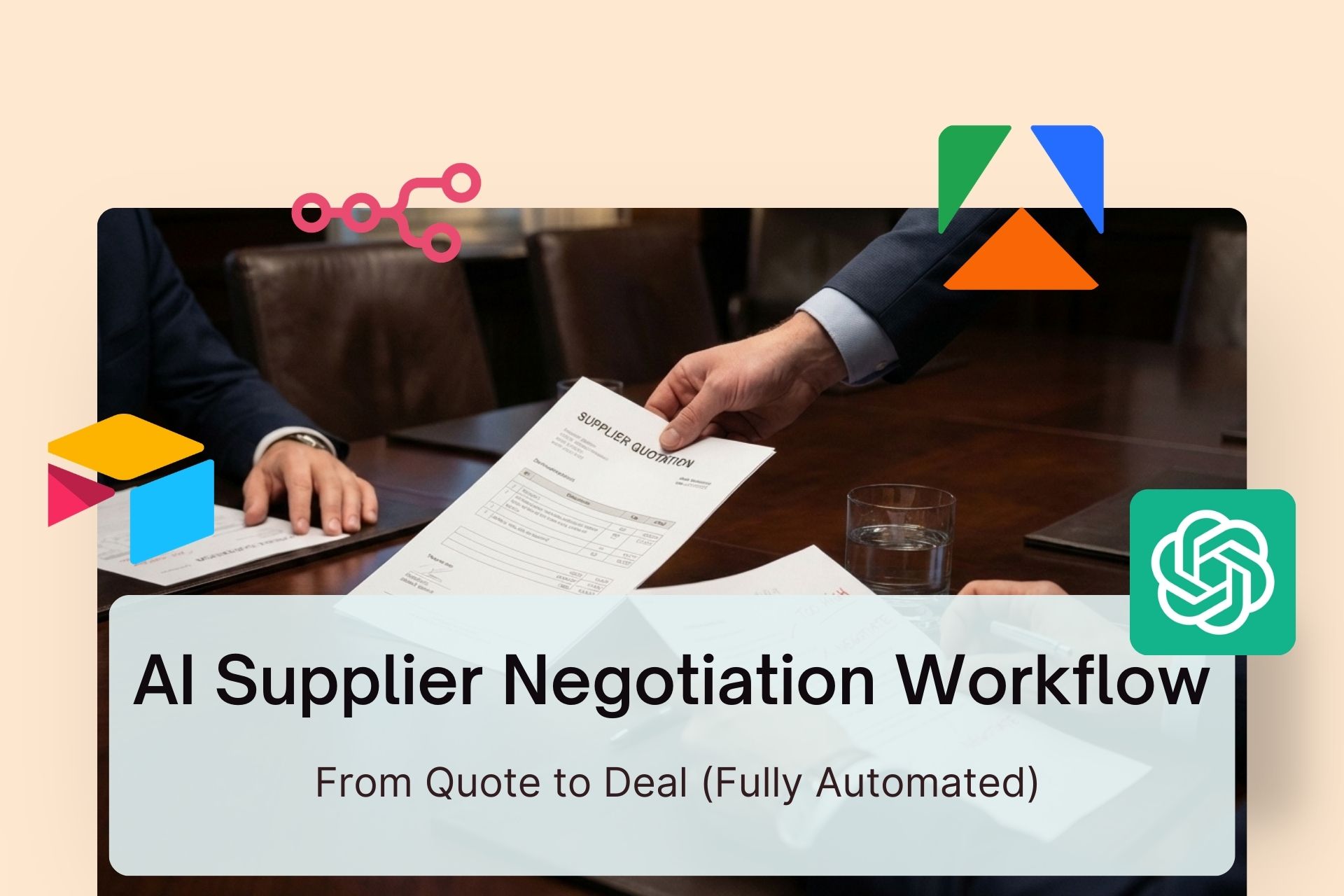
This guide breaks down a complete AI-powered supplier negotiation workflow (n8n-ready)—from raw quote parsing to strategic decision-making—fully automatable.
Quote Parsing: Turning Chaos into Structured Data
The first bottleneck is the quote itself.
Common issues:
- PDFs with inconsistent formats
- Messy Excel sheets
- Different suppliers, different structures
This makes comparison nearly impossible.
Instead of manually cleaning data, you structure it from the start.
Workflow:
- Upload PDF / Excel quotes into OCR (e.g., Document AI)
- Extract key fields automatically:
- Unit price
- MOQ
- Lead time
- Payment terms
- Store in Airtable or a database
End result: a clean, structured supplier table you can filter, sort, and analyze instantly.
The goal isn’t to “read quotes”—it’s to convert them into usable data.
Market Benchmarking: Your Negotiation Leverage
Most failed negotiations come down to one thing:
You don’t know the market price.
Without knowing:
- Average market rates
- Lowest available price
- Alternative suppliers
You’re negotiating blind.
Automate this layer using:
- Apify (scrape B2B platforms)
- SerpApi (Google & eCommerce pricing)
Collect:
- Competitor pricing
- Alternative suppliers
- Historical pricing trends
This gives you a clear price range:
- Market average
- Floor price
- Acceptable range
If you don’t know the market, you don’t have leverage.
Margin Modeling: Where Real Negotiation Power Comes From
The biggest mistake:
👉 Letting AI calculate pricing
That’s unreliable and hard to audit.
Instead:
👉 Use spreadsheets for calculation, AI for interpretation
Build a simple model in Google Sheets:
- Current cost
- Selling price
- Target margin
- Break-even price
Then use AI to answer:
- How much can we push pricing down safely?
- Can MOQ be used as a trade-off?
- What’s the optimal negotiation range?
AI should not calculate—it should analyze and recommend.
Outputs:
- Suggested discount range (e.g., 8–12%)
- Negotiation levers (MOQ, payment terms)
- Risk considerations
AI Negotiation Simulation: Practice Before You Play
This is where the real edge comes in.
Most people negotiate live, without preparation.
Top performers simulate first.
Set up a multi-agent system:
- Agent A: You (buyer)
- Agent B: Supplier
Define different supplier behaviors:
- Aggressive (resists price cuts)
- Flexible (open to negotiation)
- Delaying (stall tactics)
Run 3–5 rounds of simulated negotiation.
You’ll uncover:
- Likely objections
- Best counter-strategies
- Points of concession
This removes uncertainty and builds confidence.
The best negotiators don’t react—they prepare.
Strategy Output & Decision Tracking: Build a Long-Term Advantage
This step is often ignored—but it’s the most valuable.
Every negotiation is data.
If you don’t track:
- Final agreed prices
- Supplier behavior
- What worked vs didn’t
You’re starting from zero every time.
Set up:
Notion:
- Supplier profiles
- Negotiation history
- Strategy notes
Slack:
- Real-time decision alerts
- Strategy outputs
Over time, you build:
- A supplier intelligence database
- Behavioral patterns
- Proven negotiation strategies
This becomes your long-term competitive advantage.
How to Implement This Workflow
Start simple and layer gradually:
- Structure quotes (Document AI + Airtable)
- Add market data scraping (Apify + SerpApi)
- Build margin model (Google Sheets)
- Use AI for pricing insights
- Add negotiation simulation (n8n multi-agent)
- Track decisions (Notion)
Common challenges:
- Inaccurate data → validate across sources
- AI hallucinations → restrict AI to analysis only
- Workflow complexity → build step-by-step
Final Thoughts
Supplier negotiation isn’t about persuasion—it’s about decision systems.
When you combine:
- Market data
- Cost models
- Simulation
You shift from a reactive buyer to a strategic operator.
The future is simple:
Companies with workflows will consistently outperform those without.
The real question is:
When are you building yours?