Why So Many People Choose the Wrong AI Coding Tool
As AI coding tools keep popping up, many people share the same feeling after using them:
“It looks powerful, but somehow it doesn’t really solve the problems I care about.”
Most of the time, the issue isn’t that the tool is bad.
It’s a role mismatch.
If you use an IDE assistant to do system automation,
or try to use an agent platform for everyday coding,
it’s natural that things feel awkward or inefficient.
So before comparing features, we need to clarify one thing:
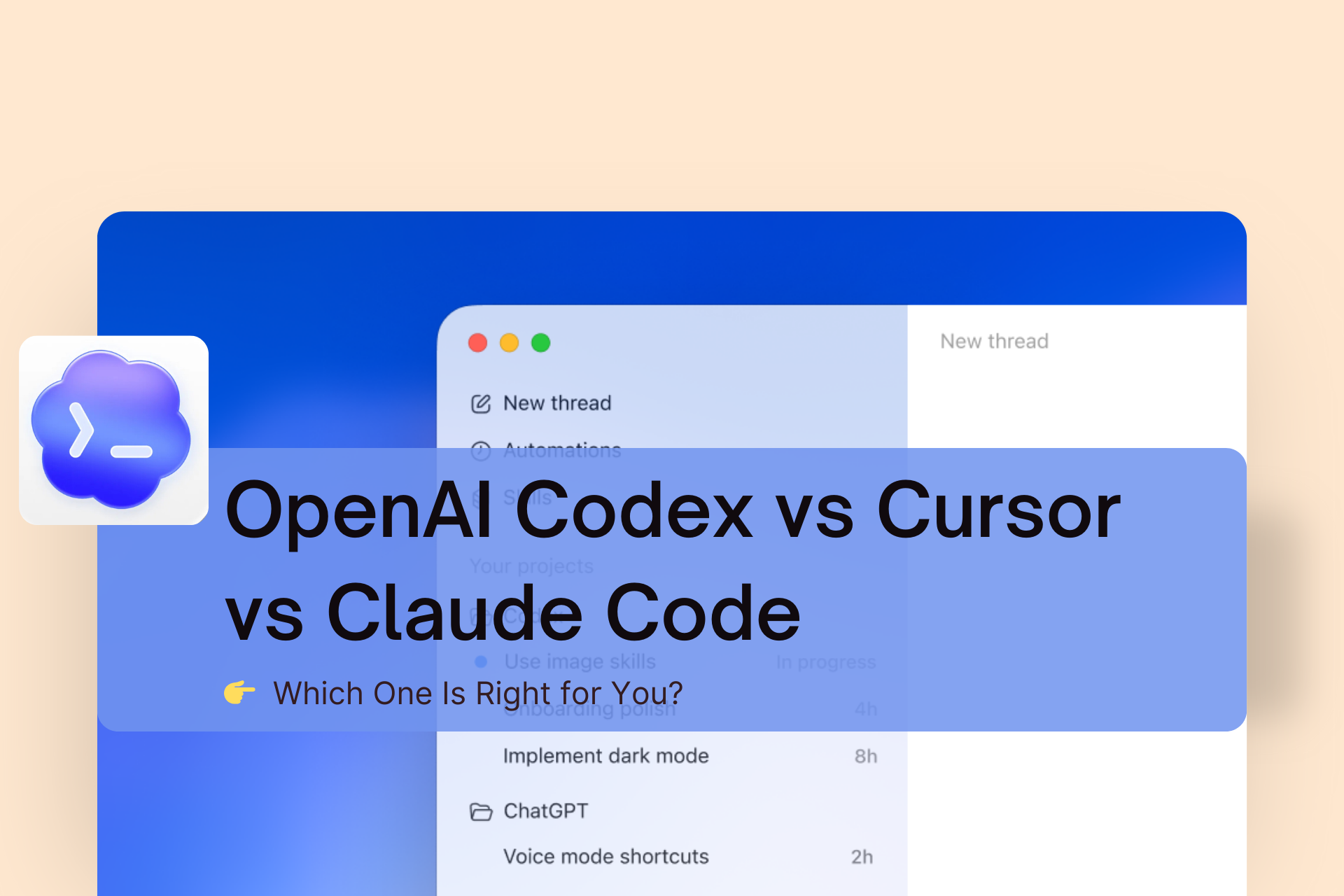
Codex, Claude Code, and Cursor represent three fundamentally different ways of thinking about AI.
🧠 One-Line Positioning (Very Important)
🔵 OpenAI Codex
👉 AI Developer Agent (Autonomous Execution Type)
- Agent-first by design
- Strong at multi-step automation
- Built for orchestration and multi-agent workflows
👉 The key question isn’t “Can it write code?”
It’s “Can this run without humans?”
🟣 Claude Code
👉 Command-Line AI Co-worker (Engineering Partner Type)
- Terminal / CLI-centric
- Strong at scripting, debugging, and refactoring
- Excellent integration with Unix toolchains
👉 Think of it as a senior engineer sitting next to you full-time.
🟢 Cursor
👉 AI Coding IDE (Most Beginner-Friendly)
- Full UI, very developer-friendly
- Strong context awareness
- Fast, smooth code generation
👉 Essentially an AI-powered version of VS Code.
⚙️ Deeper Differences You Only Feel in Real Use
① Automation & AI Workflow Capabilities
Codex clearly leads here.
Because it doesn’t just tell you how to do something —
it can actually:
- Break down tasks on its own
- Automatically write scripts
- Connect APIs and integrations
- Coordinate multiple agents to work together
👉 At this level, it’s no longer about coding.
It’s about system building.
Claude Code, on the other hand, focuses on:
- Helping you write scripts faster
- Improving and refactoring code
- Debugging more efficiently
👉 Engineering productivity is high, but it’s not fully autonomous.
Cursor mainly focuses on:
- Speeding up coding
- Reducing context switching
👉 Automation architecture is not its core strength.
② Developer Experience (Ease of Adoption)
- Cursor: Fastest to pick up
Almost no learning curve — beginners can use it immediately - Claude Code: Loved by terminal users
But there’s a learning barrier if you’re not comfortable with CLI - Codex: Steepest learning curve, highest leverage
Requires system thinking, but delivers the biggest payoff
③ AI Agent Capabilities (Next 1–2 Years)
If you believe the future looks like this:
AI isn’t just a tool — it’s a team member
Then Codex has the clearest direction:
- Research agents
- Coding agents
- Testing agents
- Deployment agents
👉 A true AI team, not just an AI assistant.
💰 Business Perspective: ROI Differences Are Significant
- Codex
- Build internal tools
- Scale automation
- Reduce dependence on human labor
👉 Best for agencies, founders, and automation strategists
- Cursor
- Improves developer productivity
- Faster coding, fewer bugs
- Claude Code
- Developer efficiency + workflow automation
- A middle-ground option
🎯 The Most Important Decision Framework
The real question has never been:
👉 “Which AI coding tool is the most powerful?”
The real question is:
👉 What role do you play in the AI workflow?
- Coder → Cursor
- Developer → Claude Code
- AI builder / automation strategist → Codex
🔥 One-Line Summary
Cursor helps you write code.
Claude Code helps you do engineering.
Codex helps you build systems.