You want “fast,” not “more editing”
Every Lunar New Year, you’re sending greetings everywhere—WhatsApp, IG captions, customer DMs, emails. You try AI… and it spits out something too long, too formal, or weirdly poetic. Then you spend more time trimming, fixing particles (呀/啦/喇), and making it sound human than if you’d just typed it yourself.
If you’re a business owner, marketer, or creator, you don’t need a thousand fancy lines. You need a tiny tool that does one job perfectly:
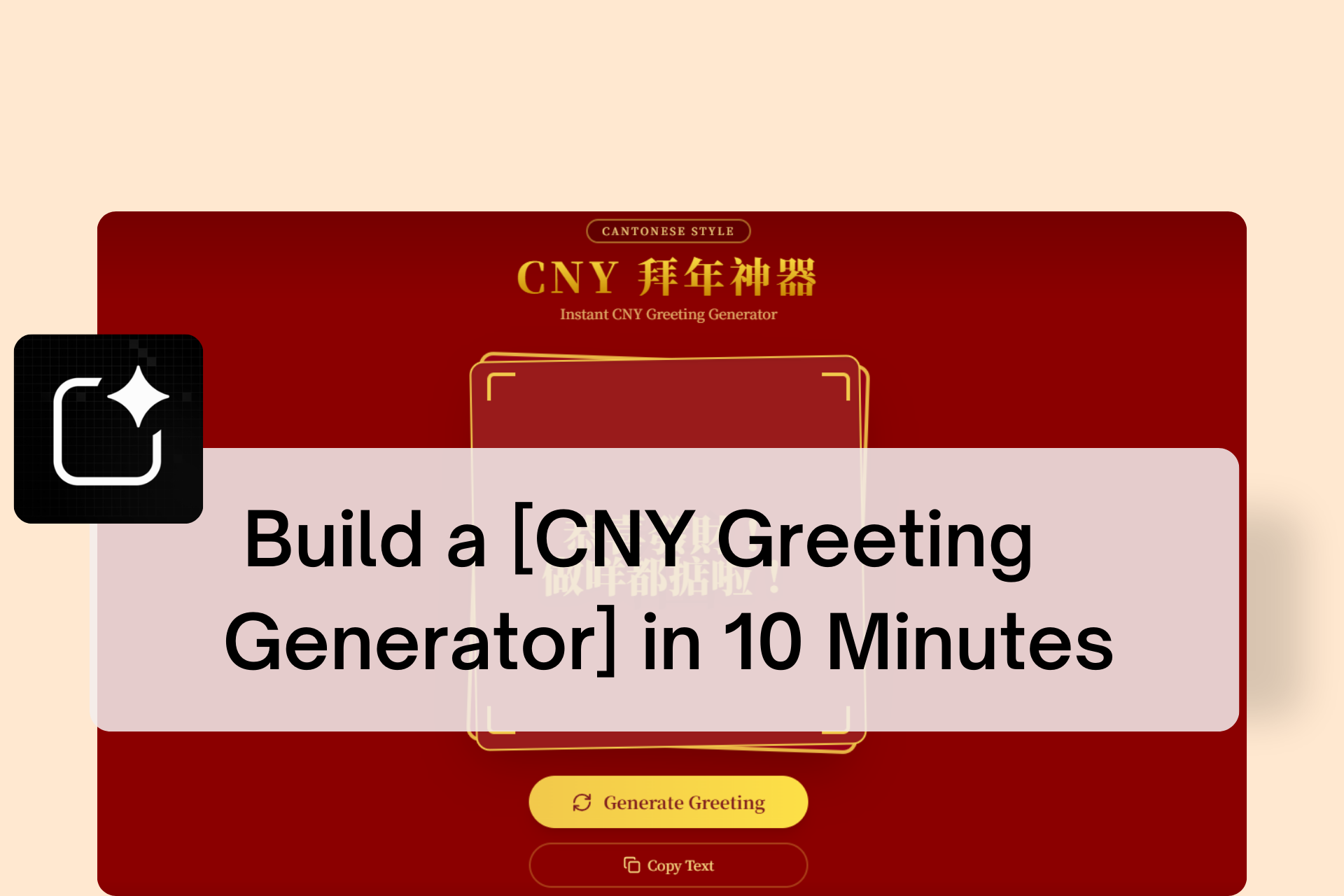
Open → tap → instantly get ONE short, spoken Cantonese CNY greeting.
In this post, we’ll “Vibe Code” a mini web app that is:
- Mobile-first
- One tap to generate
- One tap to copy
- No backend (runs as a single HTML file)
And the key is: we’ll make the AI behave by giving it strict output rules + controlled phrase pools.
Step 1: Lock the output rules (this is where most AI apps fail)
If you don’t define output constraints, the model “helps” by adding extra lines, extra blessings, or literary tone.
For a face-to-face Cantonese greeting generator, hard rules keep everything natural:
- Traditional Chinese
- Spoken Cantonese style
- Exactly 1 sentence
- ~5–15 words
- Festive + friendly
- No explanations
- No classical / poetic fluff
That’s how you get results you can say out loud immediately.
Step 2: Use phrase pools for “controlled randomness”
Instead of letting the AI invent greetings, we make it assemble greetings from predefined pools.
Formula:
Greeting = Opening + Wish + Ending Particle
This gives you variety without chaos.
Phrase Pools
Opening
- 新年快樂
- 恭喜發財
- 新一年
- 祝你今年
- 天天好運
Wish
- 身體健康
- 順順利利
- 發大財
- 開開心心
- 做咩都掂
- 心想事成
- 工作順利
- 生意興隆
Ending Particles
- 呀
- 啦
- 喇
- 呀!
- 啦!
Pull quote: “Good prompts don’t just generate words — they generate reliable outputs.”
Step 3: Paste this Vibe Coding prompt (copy/paste ready)
Use this prompt in ChatGPT / Claude / Cursor / Bolt / Lovable / any coding AI. It will generate a fully runnable HTML + CSS + JS app.
You are an expert front-end developer. Build a mobile-first, festive-but-simple single-page web app: “CNY Greeting Generator”.

Goal:
Open the app → tap → instantly get ONE short Cantonese CNY verbal greeting (Traditional Chinese, spoken style). Fast, clean UI, no backend.

Core Features:
- Title: “CNY Greeting Generator”
- Primary button: “Generate Greeting”
- On tap, randomly generate a greeting using phrase pools + logic below
- Show output text LARGE and CENTERED
- Copy button under result (copies the greeting to clipboard, shows a small “Copied!” feedback)
- Fully runnable in browser (single HTML file ok)

Output Rules (MUST follow):
- Language: Cantonese spoken style, Traditional Chinese
- Exactly 1 sentence only
- About 5–15 words (keep short)
- Festive, friendly, human
- Avoid long classical/poetic phrases
- Suitable for saying face-to-face
- Only spoken greetings (no explanations)

Phrase Pools (use exactly these items):
Opening:
- 新年快樂
- 恭喜發財
- 新一年
- 祝你今年
- 天天好運

Wish:
- 身體健康
- 順順利利
- 發大財
- 開開心心
- 做咩都掂
- 心想事成
- 工作順利
- 生意興隆

Ending Particles:
- 呀
- 啦
- 喇
- 呀!
- 啦!

Generation Logic:
Greeting = Opening + Wish + Ending Particle
Randomly pick ONE from each pool per generation.

Formatting Rules:
- Output should be wrapped in 「」 and include punctuation naturally.
- If Opening is “祝你今年” or “新一年”, it should flow naturally without weird spacing.
- Ensure the final output looks like one spoken sentence (no line breaks, no extra sentences).

Design / UI:
- Mobile-first layout, centered content
- Festive but simple (use subtle red/gold accents, not cluttered)
- Large greeting text
- Button looks tappable (rounded, shadow)
- Smooth micro-interactions (hover/active states)
- Accessible: good contrast, large tap targets

Deliverables:
- Provide HTML + CSS + JavaScript (vanilla)
- No external frameworks required
- Works by just opening the HTML file in a browser
- Include brief comments in code for clarity
Return ONLY the complete code in one code block.
Step 4: QA checklist (test this in 2 minutes)
After the AI outputs the code, open the HTML file and tap “Generate” 20 times.
Check:
- ✅ Always 1 sentence
- ✅ Always Traditional Chinese
- ✅ Always spoken (no formal/classical tone)
- ✅ Always short (5–15 words)
- ✅ Copy button works + shows “Copied!”
If anything breaks, add one more line to your prompt like:
- “Do not use commas, semicolons, or conjunctions.”
- “Do not add any extra phrases beyond the pools.”
Pull quote: “Your first version should be usable, not perfect.”
How to Apply This (and reuse the pattern for marketing)
This micro-app is a training ground for building real conversion-focused tools.
Once you’ve nailed this structure, you can reuse the same system to build:
- One-line product benefit generator (sales pages)
- Short customer support replies (DMs)
- Reels caption punchlines (social)
Same method:
- strict output rules
- controlled pools
- one clear UI action
- copy/paste delivery
FAQs
1) Why force 5–15 words?
Because spoken greetings get awkward when they’re long. Short = natural.
2) How do I stop “weird combos”?
Keep pools consistent (all spoken, all short). Test 20 taps and adjust items.
3) Can I add emojis?
You can, but it may break the “spoken only” requirement. Decide your rule first.
4) Can this become a PWA?
Yes—add a manifest + service worker. Start simple first.
5) Can I add more particles like 囉/吖?
Yes, but add slowly. Too many slang particles can reduce broad usability.
Conclusion
If you can Vibe Code a greeting generator with strict rules and controlled randomness, you can Vibe Code anything in your workflow—without drowning in manual edits.
This is what “AI ROI” actually looks like:
less tweaking, more shipping.